
Can you survive a day in Tech Industry? ft. Insightfactory.ai
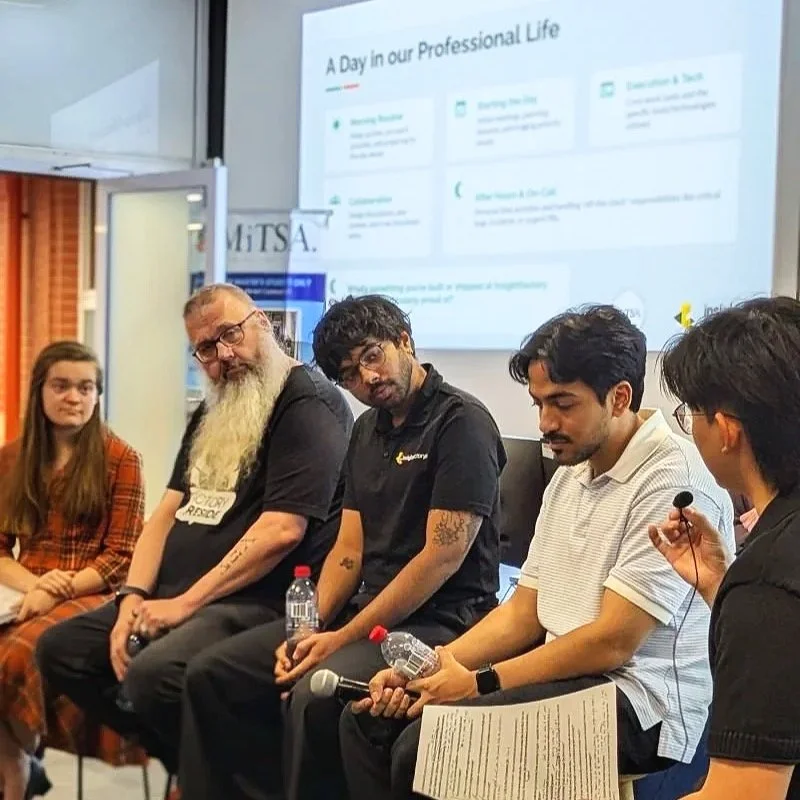
Day in the Life of an Insightfactory.ai, MiTSA Event | 30 March 2026
You have just graduated.
You have signed your first tech contract.
Your laptop is ready, your calendar is full, and your first stand‑up is about to begin. Now the real test starts:
Can you survive a full day in tech?
MiTSA hosted “Day in the Life of an Insightfactory.ai Engineer” to answer that question with real examples, not just theory. Engineers from Adelaide-based Insightfactory.ai walked us through what their days actually look like in data engineering, AI engineering, and graduate delivery work, and what skills they use over and over again.
This blog is not a recap. It is your practice run. Think of it as a simulation of your first day on the job and a guide to what you should be learning if you want to handle it.
Your first day begins…
You walk into the office.
People are already chatting across two sides of the room. You grab a desk, open your laptop, and check your calendar. In a few minutes, you will be in your first 15‑minute stand‑up, sharing what you are working on, what is next, and whether you are blocked on anything.
Now it is time to choose your path, pick your role and see what your day could look like:
-
You decide to start in data engineering.
You come in early so you can settle before stand‑ups. That quiet time is useful, because your work touches a lot of moving parts, sometimes data from 30-40 different systems in one project.
Your day
Stand‑up finishes. You update your Jira board so the team can see what you are tackling next. Then you dive into the real work: SQL. Lots of SQL.
You might be:
pulling data from different source systems
cleaning and joining messy tables
loading data into a warehouse or data lake
making sure other teams can actually use what you build
You write queries that not only work, but are also readable and consistent with team standards. At Insightfactory.ai, standardised SQL is a big deal, it makes the code easier to maintain and share.
Alongside SQL, you use Python when you need more complex logic or automation. Your data lives on cloud platforms like Databricks and Azure Synapse, so you learn how pipelines move data across these systems.
Throughout the day you:
track tasks in Jira
chat with teammates in Microsoft Teams (text instead of constant calls so people can focus)
push code to Git, where senior engineers review your pull requests
Before you log off, you fill in timesheets, update Jira tickets, and write notes in Confluence so others understand what was done, what changed, and why. Documentation is treated as part of the job, not an afterthought.
By the end of the day, one thing is very clear:
SQL is not just a subject from uni anymore. It is something you would use every single day.
To survive as a Data Engineer, you need:
strong SQL
basic Python
understanding of data pipelines and data lakes
clean documentation habits
patience with messy data
good teamwork and communication skills
-
Now imagine you joined as an AI Engineer instead.
Your morning starts the same way: stand‑up, a quick check of Jira, and a scan of your Teams messages. But your main focus is a bit different. You spend a lot of time turning fuzzy ideas into clear agentic AI systems.
Your day
A client wants back‑office automation. Another internal project aims to speed up data migration from on‑premise systems to the cloud using an “agentic data migration accelerator”. You head to a whiteboard session to break one of these problems into smaller steps.
Together with your team, you sketch:
what the AI needs to do
which tools or models it will call
how data will move between steps
where humans should stay in the loop
Back at your desk, you use Python and AI tools like Databricks Genie Code or Copilot‑style helpers to build and refine these workflows. These tools can speed you up, but you never trust them blindly, you check what they generate, fix mistakes, and shape the code to match your standards.
Your work is split between:
client projects (like automation)
internal AI products
code reviews for other team members
Every change goes through Git. Every task lives in Jira. Design decisions and tricky issues get written up in Confluence so the knowledge does not vanish when the meeting ends.
You learn quickly that AI engineering is not “just writing prompts”. It is:
problem‑solving
planning workflows
testing and debugging
explaining your ideas clearly to others
To survive as an AI Engineer, you need:
solid Python
basic understanding of AI and ML concepts
ability to break big problems into clear steps
curiosity about new AI tools (and the discipline to check their output)
strong communication and clear thinking
-
Third option: you join as a Graduate Delivery Engineer.
This role sits right at the edge between tech and the client. Your work is technical, but it is always driven by what real organisations need.
Your day
You might start with a stand‑up, then jump straight into a client call. One project could be a quarterly IT report. Another might be automation work for a large transport organisation. Right now, you might be working on “one‑hour compliance” checking whether clients are paying employees correctly under Australian Modern Awards.
Your day includes:
making and updating reports
building small automation or data engineering pieces
checking rules and compliance logic
switching between different client requests
You still use many of the same tools:
SQL and Python for data and automation
Jira and Confluence for work tracking and documentation
Microsoft Teams for internal and client communication
Git for any code you contribute
You learn a lot, fast. The work changes often, and you need to ask good questions so you understand what the client actually cares about.
To survive as a Graduate Delivery Engineer, you need:
willingness to learn quickly
strong communication skills
basic data and automation experience
good organisation
confidence to ask questions
comfort with client‑facing work
The reality check: it is not just coding
Whichever path you pick, the shape of the day has a few common threads.
There are stand‑ups and other meetings. There are Jira tasks, Confluence notes, and Teamsmessages. There are code reviews, where senior engineers check pull requests for quality and naming conventions. There are timesheets, especially when billing is time‑and‑materials.
After‑hours work does appear. Most projects at Insightfactory.ai are not critical infrastructure, and the team said expectations are reasonable, but almost every IT contract will include some level of after‑hours effort. Good employers should recognise this with time off, pay, or other recognition, and constant late nights are a red flag for poor project management.
Self‑learning is also part of the picture. Neil and Sanchit both pointed out that they often research new AI tools or try new tech in their own time because they enjoy it, but stressed this should be driven by personal interest, not pressure.
The message is clear:
Tech work is exciting, but it is also structured, team‑based, and practical.
Communication, documentation, and collaboration matter just as much as raw coding skill.
-
Here is what all of this means for your learning plan.
SQL
Real data work means pulling, cleaning, joining, and understanding data from many systems. SQL is still “king” in data engineering and used every day.Python
Python complements SQL, supports automation, and underpins a lot of AI and data work. It is one language that opens many doors.Databricks and Azure Synapse
These are the kinds of platforms used for data lakes and large‑scale data work. Even if you use different tools at uni, thinking in terms of cloud data platforms will help you match industry practice.Git
Version control is essential. Teams rely on Git and code review workflows to manage changes safely and keep shared codebases healthy.Jira
Most teams plan work in Agile sprints. Jira is where tasks live, progress is tracked, and blockers are recorded. If you understand this, you will feel less lost in your first stand‑up.Confluence
Documentation is kept here: decisions, designs, issues, agreements on what will be built. These pages become the project’s memory.Microsoft Teams
This is where day‑to‑day communication happens, especially quick text messages that avoid interrupting deep work.AI coding tools (like Databricks Genie Code or Copilot‑style tools)
These tools are becoming standard, but they assist; they do not replace you. You still need to understand the code, test it, and own the result.
-
If you want to be ready for a day like this, here is how you can start preparing.
Build a SQL + Python data pipeline project.
Pull data from multiple sources, clean it, join it, and load it into a small warehouse‑style structure. This mirrors real data engineering work.Create a dashboard or reporting project.
Pick a business‑style problem: transport, retail, uni data, anything — and build reports that someone could actually use.Try a small AI automation project.
Use Python and an AI tool to streamline a real task. Focus on breaking the problem into steps, not just calling an API once.Host your work on GitHub.
Use clear commits, branches, and pull requests if you can. Write a strong README so someone else can understand and run your project.Practise documentation.
Write short design notes and “issue logs” like you would in Confluence. Explain decisions, problems, and how you solved them.Learn basic Agile and Jira workflows.
Even a simple board with “To Do / In Progress / Done” can help you understand how tasks move through a sprint.Practise explaining your projects in simple language.
If you can talk clearly about what you built and why, you are already building one of the most important skills in industry.
Key takeaways
SQL is still one of the most important data skills.
Python gives you flexibility across data, automation, and AI work.
Git is not optional if you want to work in a real team.
Documentation (timesheets, Jira, Confluence, code comments) is part of the job, not extra work.
AI tools are powerful helpers, but they do not replace your own thinking.
Communication and collaboration can make or break technical work.
Real projects are messy, so build projects that solve real‑world problems, not just perfect tutorials.
The best preparation is not just learning tools, but using them in practical, end‑to‑end projects.
Conclusion
So, can you survive a day in tech at a place like Insightfactory.ai?
You can, if you are ready for more than just code. You need skills in SQL and Python, habits around Git, Jira, and Confluence, and the mindset to keep learning, documenting, and working well with others. That is what this event showed so clearly: real tech work is human, practical, and built on the small, consistent habits you start practising now.
If you want to know what industry really expects before you step into it, stay close to MiTSA. The club keeps bringing these conversations to life through events, panels, and networking sessions with professionals. If you want to learn, connect, and see where your degree can take you, make sure you do not miss the next MiTSA’s Industry Night.