
Apply Like You Mean It: What I Learned About Resumes, Cover Letters and Getting Noticed in Australia
Writing a resume sounds simple until you actually sit down to do it.
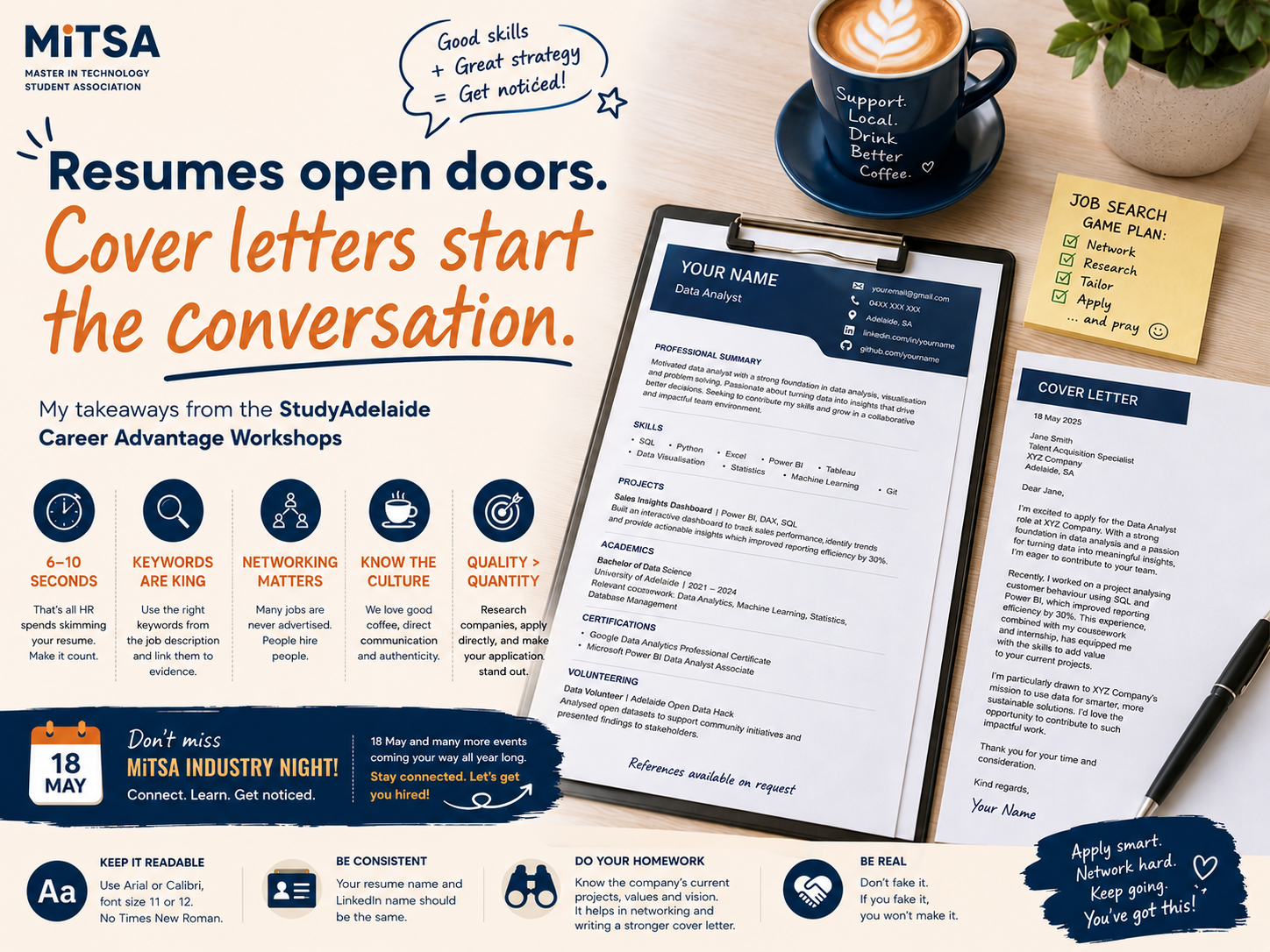
I recently, attended the StudyAdelaide Career Advantage Workshops, where I learned a lot about how resumes and cover letters work in the Australian job market. This blog is not a magic formula that guarantees a job overnight. Sadly, I do not have that spell yet. But it is a practical guide to help you apply smarter, especially if you are a student, graduate, or early-career applicant trying to break into the market.
Because here is the truth: the job market is tough, but applying blindly makes it tougher.
So let’s talk about how to write a resume and cover letter that actually make sense in Australia, and my key takeaways from the workshop

-
Before we talk about formatting, keywords or cover letters, we need to understand one thing: every country has its own job application culture.
In Australia, employers usually value clear communication, honesty, relevance and professionalism. They do not want a ten-page life story. They also do not want a mystery puzzle where they have to search for your skills like hidden treasure.
Also, please use Australian English.
Not US English. Australian English.
That means analyse, not analyze. Organise, not organize. Behaviour, not behavior. It might look like a small detail, but small details show cultural awareness. If you are applying in Australia, your language should match the country you are applying in.
Think of it this way: do not tell an Australian hiring manager you still choose Starbucks over the good local coffee shop around the corner. The coffee culture is strong here. People notice these things.
Your job application should make the recruiter’s life easier.
That means your resume should quickly answer:
Who are you?
What can you do?
Where have you used those skills?
Why are you a good fit for this role?
If the recruiter has to work too hard to find the answer, they may simply move on. Not because they are mean, but because they may have hundreds of applications to check.
And no one enjoys doing detective work at 4:45 PM on a Friday.
-
One thing I have learned is that Adelaide may be a city, but professionally, it can feel like a very large group chat.
Let’s say you are applying for a data analyst role at a company. You may have attended networking events, met people in that field, spoken to someone from a panel, or connected with professionals on LinkedIn. There is a real chance that the hiring manager knows someone you know.
That is why networking matters so much here.
But should you put those people’s names directly under “References” on your resume?
No.
Privacy matters. Do not list someone as a reference unless they have clearly agreed to it and you are at the reference-checking stage. The safer and more professional line is: References available upon request.
After the interview, if the employer asks, then you can provide references who are ready to speak about you.
The point is this: build genuine relationships, attend events, talk to people, follow up professionally, and let your network support you at the right time.
Do not turn your resume into a public contact list.
-
Before applying for any role, read the job description properly.
Not skim. Not “vibe check”. Actually read it.
Sometimes a role title sounds perfect, but the role itself may not be for you. A “Data Analyst” position might actually require five years of commercial experience, advanced cloud engineering, stakeholder management, and the ability to fix the office printer through sheer willpower.
That may not be an entry-level role.
When reading a job description, pay attention to two categories:
1. Must-have requirements
These are essential. They are the minimum criteria.
If the job says you must have Australian working rights, a specific certification, advanced SQL, or professional experience in a certain area, they mean it.
If you miss a must-have requirement, there is a strong chance your application will be filtered out early.
2. Desired requirements
These are nice-to-have skills. If you meet them, great. If you do not meet all of them, you may still apply if you meet the must-haves.
This is where many students get confused. You might match all the desired skills, but if you miss a must-have, the application may not go far.
Think of it like this: the tech team tells HR, “We need someone with SQL, Power BI, Git and machine learning.” HR may not be technical enough to know that your deep learning project is related to machine learning. They are often checking whether the resume clearly says the things listed in the job description.
So if the job description says “machine learning” and your resume only says “deep learning”, do not assume they will connect the dots.
Connect the dots for them.
-
Here is the painful truth: your resume may only get around 6 to 10 seconds of attention in the first skim.
That is not much time.
That means the recruiter is not reading every beautiful sentence you wrote. They are quickly checking whether your resume looks relevant enough to go into the interview pile instead of the bin.
So make sure they can see the important keywords quickly. Put your key skills near the top. Use clear headings. Keep the layout clean. Do not hide the strongest evidence halfway down page two.
Your goal is simple: in those few seconds, the recruiter should immediately think, “Yes, this person matches what we asked for.”
-
A resume is not just a document. It is a matching exercise.
The company says, “Here is what we need.”
Your resume should say, “Here is where I match what you need.”
That is why keywords matter.
If the job description mentions Excel, SQL, Python, dashboarding, stakeholder communication, data cleaning or customer service, and you genuinely have those skills, use the same language in your resume.
Do not make the recruiter translate your experience.
No one likes it when someone makes their life harder. That includes recruiters, hiring managers and your group assignment teammates.
The smart approach is to create one strong base resume, then tweak it for each role. You do not need to rebuild your resume from scratch every time. But you should adjust the wording, skills and project descriptions so they match the role.
A resume that is slightly tailored is much stronger than one generic resume sent to fifty companies with “Dear Hiring Manager” energy.
-
For students and graduates, recruiters need to understand your skills quickly.
A strong structure can look like this:
Contact details
Personal statement
Key skills
Projects
Education
Certifications
Relevant work experience
Volunteering or leadership experience
This is not the only structure possible, but it works well for early-career applicants because it puts your strongest evidence near the top.
Your skills should not be randomly hiding at the bottom of page two like a side quest.
Put them where they can be seen.


-
Your resume does not need to look like a design portfolio unless you are applying for a design role.
Keep it clean, consistent and easy to skim.
Use a font size around 11 or 12. Not too big, definitely not too small. Again, do not make the recruiter’s life harder.
Also, keep the font size consistent across your resume and cover letter. They should feel like they belong together, not like two documents from different planets.
And please, do not use Times New Roman.
Times New Roman belongs in academic essays, journal papers and possibly ancient university computers. For corporate resumes, use something more readable and modern, like Arial or Calibri.
The goal is not to impress someone with fancy formatting. The goal is to make your experience easy to understand quickly.
-
Anyone can write “Python, Excel, Power BI, teamwork, communication” on a resume.
The real question is: where is the evidence?
If you say you know Excel, show where you used it.
For example:
Built an Excel dashboard to analyse sales performance across regions
Used pivot tables and charts to summarise customer behaviour
Cleaned and transformed raw survey data using Excel formulas
If you say you know Python, link it to a project, assignment or work experience.
For example:
Developed a machine learning model in Python using pandas and scikit-learn
Cleaned and analysed parking expiation data using Python and visualisation libraries
Built a recommendation system using text preprocessing and cosine similarity
The rule is simple:
No evidence, no trust.
Your skills should connect to your projects, academics, certifications, work experience or volunteering.
Otherwise, it just looks like you copied a skills section from the internet and hoped for the best.
-
This one is simple.
Do not lie on your resume.
Do not list tools you have never used. Do not claim experience you do not have. Do not write “advanced SQL” if your current relationship with SQL is “SELECT * FROM panic”.
You may think it helps you pass the first filter, but it can destroy you in the interview.
Experts can tell when you are faking. They will ask follow-up questions. They will know.
And once they know, the trust is gone.
There is a big difference between presenting yourself confidently and pretending to be someone you are not.
Be honest, but do not undersell yourself.
If you are still learning a tool, say it through evidence. For example:
Currently building Power BI dashboards using public datasets to strengthen business reporting and data storytelling skills.
That sounds much better than pretending you have five years of enterprise dashboarding experience when you opened Power BI for the first time last Tuesday.
If you fake it, you probably will not make it.
-
Your personal statement does not need to be four paragraphs long.
Four lines can be enough.
It should explain:
Who you are
What you are studying or doing
What your career goal is
Why this role fits that goal
For example:
Master of Data Science student with experience in Python, R, SQL and data visualisation. Interested in using analytics and machine learning to solve practical business problems. Currently building projects in dashboarding, predictive modelling and data storytelling. Seeking a data analyst role where I can apply technical skills, communicate insights clearly and grow in a collaborative team.
That is clear. It tells the recruiter what they need to know.
No dramatic monologue required.
-
In Australia, it is usually better not to include a photo on your resume.
Recruitment processes aim to reduce bias, and a photo can create unnecessary bias based on appearance, age, gender, ethnicity or other factors. Even if you look amazing, professional and LinkedIn-ready, your resume is not the place for a headshot.
Save the photo for LinkedIn.
Your resume should focus on your skills, experience and evidence.
Not your jawline.
-
Your resume should include:
Full name
Phone number
Professional email address
LinkedIn profile
GitHub or portfolio website, if relevant
City and state, such as Adelaide, SA
Also, make sure your resume name and LinkedIn name match.
If your resume says “Vaibhav Patil” but your LinkedIn says “V Patil Data Ninja 🚀”, it creates unnecessary confusion. Keep your professional identity consistent across documents and platforms.
You do not need to include your full home address or letterbox-level details. The recruiter does not need to know exactly where your microwave lives.
City and state are enough.

-
Some people treat cover letters like a boring formality.
In Australia, they can matter a lot.
Even if a company says the cover letter is optional, do the optional thing.
Because optional often means: “Here is your chance to show effort.”
A resume shows your evidence. A cover letter shows your fit, motivation and personality.
This is where you explain why this role, why this company and why you.
-
A cover letter should not sound like a robot wearing a blazer.
It should sound professional, but still human.
You should explain:
Who you are
What you are currently doing
What you have done so far
Why you are applying for this role
How the role connects with your career goals
What value you can bring
Keep it focused. Keep it one page.
One page only.
Not one page plus “just a tiny bit on the second page”. That is how chaos begins.
-
Just like your resume, your cover letter should reflect the job description.
If the job mentions data analysis, stakeholder communication, reporting, Python, SQL or problem-solving, and you genuinely match those areas, include them.
But again, do not just claim.
Link the claim to evidence.
Instead of writing:
I have strong data analysis skills.
Write something like:
Through my data science projects, I have used Python, SQL and visualisation tools to clean datasets, identify patterns and communicate findings in a way that supports decision-making.
That is stronger because it shows where the skill comes from.
A good cover letter does not just say “trust me”.
It says “here is why you can trust me”.
-
For resumes, tweaking is usually enough.
For cover letters, write a fresh one for each job.
Yes, it takes longer.
Yes, it is annoying.
Yes, your future employed self will thank you.
A cover letter should feel specific to the company and the role. If your cover letter could be sent to any company in any industry, it is probably too generic.
The company should feel like you chose them, not like they were applicant number 47 in your spreadsheet of suffering.
-
Before writing your cover letter, look at what the company is currently working on.
Check their website, LinkedIn page, recent projects, values, mission, vision and even their tone of communication. This helps you understand what they care about.
It also makes networking easier. If you meet someone from the company, you can ask better questions than, “So... what does your company do?”
More importantly, it helps you write a better cover letter. When you mention a current project, company value or direction that genuinely interests you, it shows effort. It tells them you are not just applying randomly. You actually looked into them.
And yes, hiring teams can usually tell the difference.
-
A small personal touch can help.
If possible, find the recruiter or hiring manager on LinkedIn or the company website. If you know their name, address the cover letter to them instead of writing “Dear Hiring Team”.
For example:
Dear Sarah,
This feels more personal than:
To whom it may concern,
Which sounds like you are writing to a haunted office printer.
Of course, if you cannot find the name, “Dear Hiring Team” is still fine. But if you can personalise it, do it.
-
AI can help you structure your cover letter, improve clarity and check grammar.
But do not let AI remove your personality.
Many applicants use AI now. The problem is not using AI. The problem is using it badly.
If your cover letter sounds like:
I am writing to express my enthusiastic interest in this esteemed opportunity at your prestigious organisation...
Please stop.
No one talks like that. Not even the organisation.
Make it personal. Add your story.
For example, imagine you are applying for a data analyst role at Booking.com. You could write about how family holidays shaped your love for travel, and how you now want to use data skills to help improve travel experiences for others.
That is much more memorable than writing:
I am passionate about leveraging data-driven insights to optimise customer-centric solutions.
That sentence is technically fine. It also sounds like it was assembled in a corporate microwave.
Your story matters. Use it.
-
Another big lesson: do not apply blindly.
Job platforms are useful, but they should not be your only strategy.
Sometimes jobs listed on platforms like LinkedIn are also available directly on the company website. If you are serious about a role, go to the company’s careers page and apply there as well, or prioritise the official company application portal when possible.
Then take one extra step.
Find the recruiter, hiring manager or someone relevant in the team. Send a short professional message or email after applying.
Not a desperate essay.
Just a polite note introducing yourself, mentioning that you applied, and briefly explaining why you are interested.
This helps you become more than just one name in a pile.
Because the reality is that many jobs are filled through networks, referrals or internal recommendations before they are widely noticed. Networking does not replace skills, but it helps people discover your skills.
In Australia, networking is not just “nice to have”. It can be one of the most important parts of your job search.
-
The market is competitive. Everyone is applying.
So you need to put up a fight for your place.
That does not mean being annoying. It means being intentional.
Read the job description properly. Tailor your resume. Write a real cover letter. Apply through the company website. Reach out professionally. Attend networking events. Build projects. Follow up. Keep learning.
Get noticed for the right reasons.
Because sometimes the difference between two applicants is not talent.
It is effort, clarity and timing.
This part was not from the workshop. This is just from real life.
Apply and pray.
The market is tough everywhere, and rejection is part of the process. Sometimes you can do everything right and still not get the role. That does not mean you are not good enough. It means the process is competitive, unpredictable and sometimes painfully slow.
So keep going.
Improve your resume. Improve your cover letter. Build better projects. Talk to more people. Attend more events. Ask for feedback. Try again.
You only need one good yes.

And speaking of networking...
MiTSA has Industry Night coming up on 18 May, and events like this are exactly where you can start building the connections we keep talking about.
You get to meet people from research, industry and student communities. You hear real career stories. You ask questions. You learn what employers actually care about. Most importantly, you become visible.
MiTSA will continue running events throughout the year, so keep an eye out.
Come to the events. Talk to people. Ask questions. Follow up. Build your network before you desperately need it.
Let’s get you hired. Or at least get your resume out of the “generic applicant” zone.
That is already a very good start.